Early signals from research data
Connect companies, people and research through source-linked keywords and graph-based retrieval.
The problem
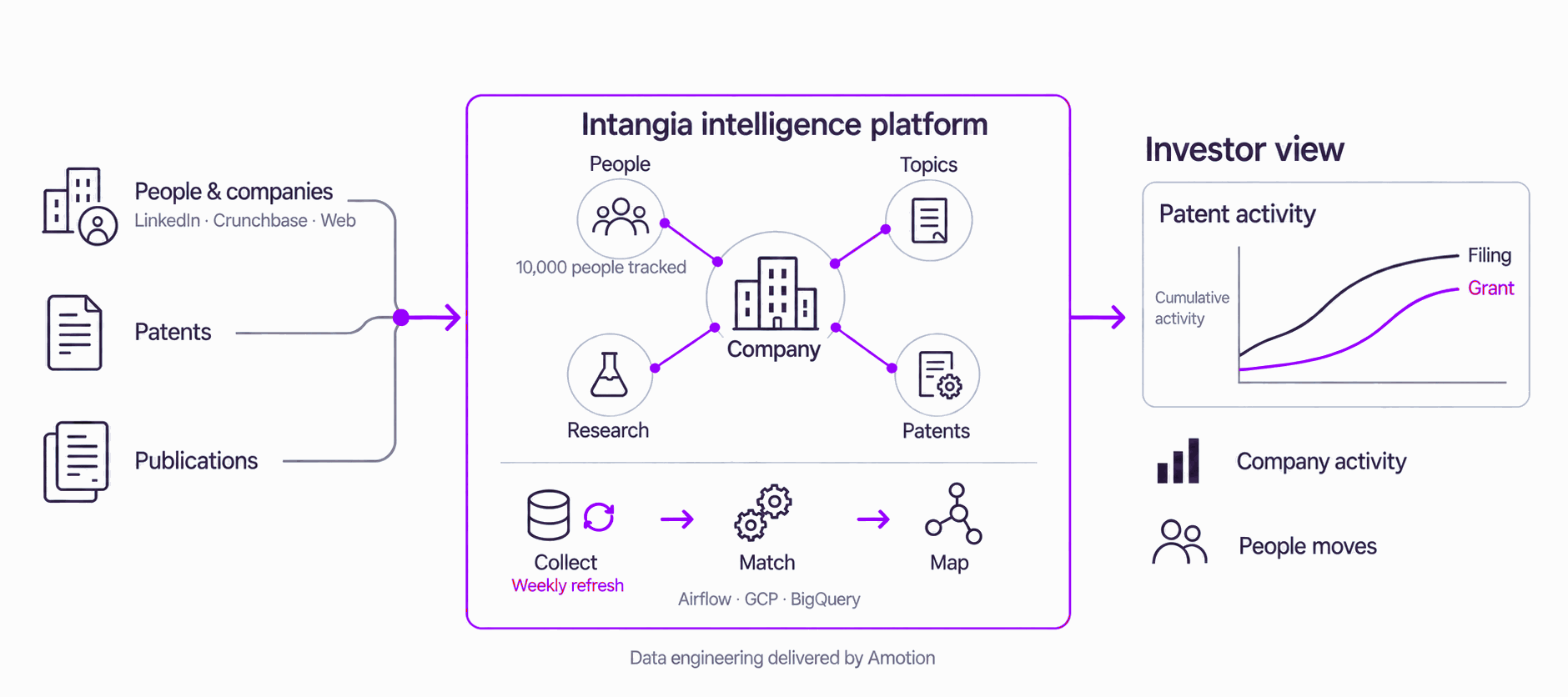
Company and researcher profiles relied on outdated keywords from conventional text extraction, across a corpus of more than 7 TB from many sources. Better keywords from patents and publications had to fit the existing database and backend.
What we built
Data pipelines and a backend that connect companies, people and research, using topic modelling, entity matching and graph-based retrieval.
Where it runs
In the customer environment, with a data warehouse, scheduled pipelines and a knowledge graph. Data refreshes weekly.
Document-linked research retrieval operating across more than 7 TB.
In production in the client’s product, refreshed weekly.
Industry: investment intelligence. Client details and metrics are shared after an NDA, to protect our clients’ interests.
From source to a reviewed answer, in three steps.
- 01
Papers and patents
Research documents refreshed through scheduled pipelines.
- 02
Connect the records
Extract keywords, match entities and build graph-based retrieval.
- 03
Analysts explore
Follow signals and links in the profiles they already use.
System capabilities
- Storage
- Data warehouse
- Scheduled loads
- Pipelines
- Scheduled pipelines
- Weekly refresh
- Topics
- Topic modelling
- Clustering
- Graph
- Knowledge graph
- Graph retrieval
- Context
- LLM keyword extraction
- Entity and ontology mapping
Discuss your research intelligence workflow.
Tell us about your research sources and how your team uses them today. We’ll help you identify a practical starting point.
founders@amotion.ai